1

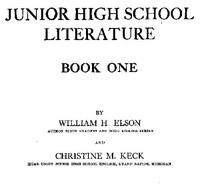
Junior High School Literature, Book 1 — Reading Companion
2022
5
Project Gutenberg
2017
English literature; Readers; American literature
Readers of public-domain and historical texts
Project Gutenberg digital edition
en
Edition facts
Words: 246,351
Reading time: 1072 min
Text sections: 35
Source:
Project Gutenberg record #54825
This 1919 anthology for first-year junior high students organizes literature around social ideals, featuring works by O. Henry, Theodore Roosevelt, Walt Whitman, and others, with a preface emphasizing patriotism, service, and nature.
Editorial Edition Score
4.9/5
★★★★★
★★★★★
Calculated from edition completeness, EPUB availability, text structure and catalogue metadata. Not a user rating.
Edition quality
The preface of Junior High School Literature, Book 1 explicitly frames the anthology as a tool for teaching “certain fundamental American ideals” in the wake of World War I. Editors William H. Elson and Christine M. Keck aim to “marshal the available material, setting it to work in the service of social and civic ideals,” prioritizing themes like freedom, loyalty, courage, and love of nature. This editorial mission shapes the selection of texts, which range from O. Henry’s “The Gift of the Magi” to Theodore Roosevelt’s “Old Ephraim, the Grizzly Bear” and Walt Whitman’s “O Captain! My Captain!” The volume’s structure reflects a deliberate attempt to connect literature to life, with each piece chosen to illustrate a specific ideal.
Patriotic Poetry and Prose
The anthology includes several poems and prose pieces with overt patriotic themes. For instance, Sir Arthur Conan Doyle’s “The Guards Came Through” and Thomas Hardy’s “Men Who March Away” both originally appeared in The London Times during World War I. John Galsworthy’s “England to Free Men” and R. W. Lillard’s “America’s Answer” further reinforce nationalistic sentiments. Walt Whitman’s “Pioneers! O Pioneers!” and “I Hear America Singing” celebrate American labor and expansion. The inclusion of these works aligns with the preface’s stated goal of teaching “personal, social, national, and patriotic” ideals. Notably, the editors also include Whitman’s “O Captain! My Captain!,” a Civil War elegy for Abraham Lincoln, which bridges mourning and national unity.
Nature and Animal Life
Several selections focus on nature and animals, reflecting the preface’s emphasis on “love of Nature” and “humane treatment of animals.” Theodore Roosevelt’s “Old Ephraim, the Grizzly Bear” offers a firsthand account of hunting a grizzly, blending natural history with adventure. Hamlin Garland’s “The Great Blizzard” from Boy Life on the Prairie depicts a harsh winter storm through a child’s perspective. Joyce Kilmer’s “Trees” and Sidney Lanier’s “On a Florida River” provide lyrical nature poetry. The anthology also includes Alfred Noyes’s “Kilmeny—A Song of the Trawlers,” which portrays the lives of fishermen. These texts collectively present nature as both a source of beauty and a setting for human struggle.
Historical and Adventure Narratives
The excerpt from Sir Richard Grenville’s fight aboard the Revenge exemplifies the anthology’s inclusion of historical adventure. The passage describes a fifteen-hour battle against fifteen Spanish ships, with Grenville ordering his ship to be sunk rather than captured. The narrative emphasizes courage and defiance: “By those hundred all was sustained, the volleys, boardings, and enterings of fifteen ships of war.” The text also includes a dispute between Grenville and his captain over surrender, highlighting themes of honor and duty. This selection, likely from a primary source, aligns with the editors’ aim to teach “service, loyalty, courage” through literature. The vivid, detailed prose offers students a concrete example of historical heroism.
Readers approaching this anthology should note its deliberate organization around social ideals rather than chronology or genre. The preface provides a clear lens for interpreting the selections, which are chosen to illustrate specific values like thrift, humor, and the dignity of work. The excerpts reveal a mix of canonical authors and lesser-known works, all serving the editors’ pedagogical mission. This context enriches the reading experience, inviting reflection on how literature can shape civic identity.
Reader reflection
Before you leave, reflect on the book
Use these questions to collect your thoughts before moving on.
Your progress
0
/
10
2
How much did you enjoy the reading experience?
3
Would you pass this book on to a friend?
4
How much effort did this book require?
5
What did you appreciate most?
6
Did the book deliver what you hoped for?
7
How understandable was the text?
8
Would you like to discuss this book with someone?
9
What did this book teach you most?
10