1

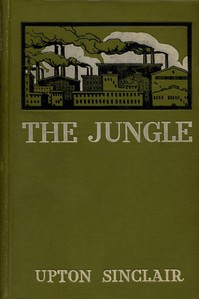
The Jungle — A Reader’s Guide
24
3
Project Gutenberg
2006
Meat industry and trade -- Fiction; Working class -- Fiction; Political fiction; Lithuanian Americans -- Fiction; Stockyards -- Fiction; Immigrants -- Fiction; Chicago (Ill.) -- Fiction
Readers of public-domain and historical texts
Project Gutenberg digital edition
en
Edition facts
Words: 155,569
Reading time: 677 min
Text sections: 32
Source:
Project Gutenberg record #140
Upton Sinclair's 1906 novel follows Lithuanian immigrants in Chicago's Packingtown, tracing their descent from a hopeful wedding feast to eviction and despair. The excerpts show a narrative that moves from communal celebration to individual crisis, with the protagonist Jurgis confronting the loss of his home and family.
Editorial Edition Score
4.9/5
★★★★★
★★★★★
Calculated from edition completeness, EPUB availability, text structure and catalogue metadata. Not a user rating.
Edition quality
The opening chapter of The Jungle immerses the reader in a Lithuanian wedding feast, where the character Marija Berczynskas dominates the scene with her physicality and voice. She 'flung up the window of the carriage' to berate the coachman in two languages, a detail that immediately establishes the immigrant community's linguistic duality and Marija's forceful nature. The setting is precisely located 'in that part of Chicago known as “back of the yards,”' grounding the narrative in the stockyards district. The wedding is presented as 'the supreme hour of ecstasy' for the bride Ona Lukoszaite, a phrase that foreshadows the contrast between this moment and the hardships to come.
Catalog Subjects vs. Narrative Focus
The catalog subjects list 'Meat industry and trade -- Fiction' and 'Stockyards -- Fiction,' yet the excerpts do not depict any meatpacking work. Instead, the narrative centers on domestic and communal life: a wedding, a home, and the search for displaced family. The industrial setting is present only as a geographic marker—'back of the yards'—not as a workplace. This discrepancy suggests that the novel's reputation as an exposé of the meat industry may overshadow its sustained attention to the immigrant family's social and economic struggles. The excerpts show Jurgis's crisis upon finding strangers in his house, a scene that dramatizes housing insecurity rather than industrial labor. Readers expecting detailed descriptions of slaughterhouse conditions will find them later in the text, but the opening sections prioritize the personal and familial over the occupational.
Voice and Linguistic Texture
The narrative voice shifts between a detached, almost documentary tone and a deeply sympathetic interiority. The wedding scene is described with matter-of-fact precision—'the rear room of a saloon'—yet immediately pivots to a lament: 'how pitifully inadequate it would have seemed to one who understood.' This dual register characterizes the novel's approach: it presents facts while insisting on their emotional weight. The excerpts also incorporate Lithuanian and Polish phrases ('Eik! Eik! Uzdaryk-duris!'), embedding the characters' native languages into the English text. This technique reinforces the cultural specificity of the community and the barrier between the characters and the English-speaking reader. The narrative does not translate these phrases, leaving them as markers of a world that resists full assimilation into the dominant language.
The House as a Symbol of Rupture
The later excerpt centers on Jurgis's return to find his home occupied by strangers. The house, which he had bought and paid for, has been repainted and sold again. The scene is structured around a series of confrontations: first with a boy making a snowball, then with an Irishwoman who claims to have bought the house. Jurgis's repeated question—'Where is my family?'—goes unanswered, and the narrative describes his confusion as 'as if his family had been wiped out of existence.' The house, once a symbol of stability, becomes a site of dispossession. The detail that the house was 'repainted and sold again the next week' after the family was evicted underscores the rapid turnover of property in the neighborhood. Jurgis's breakdown on the steps of a saloon, 'shaking all over with dry, racking sobs,' marks a turning point from hope to despair.
The excerpts from The Jungle reveal a novel that begins not in the factory but in the home, and that traces the dissolution of a family through the loss of that home. Readers should attend to the way Sinclair builds a world through sensory details—the 'dull “broom, broom” of a cello,' the 'new, white curtains, stiff and shiny'—and through the rhythms of speech and silence. The catalog subjects point toward industrial exposé, but the text itself insists on the human cost of economic precarity, one family at a time.
Reader reflection
What was your reading experience?
Capture what you thought, learned, and would like to remember.
Your progress
0
/
10
2
What was your overall reaction to the book?
3
How likely are you to recommend this book?
4
What was the reading difficulty like?
5
How closely did the book connect with your experience?
6
Did you gain anything practical from the text?
7
Could you see yourself revisiting this book?
8
Did this book create an emotional response?
9
In one sentence, what did you learn?
10