1

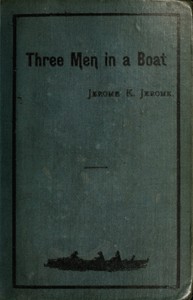
Three men in a boat (to say nothing of the dog) — A Reader’s Guide
1419
5
Project Gutenberg
1995
Young men -- Travel -- England -- Thames River -- Fiction; Boats and boating -- England -- Thames River -- Fiction; Dogs -- Fiction; Humorous stories, English; Thames River (England) -- Fiction; Male friendship -- Fiction
Readers of public-domain and historical texts
Project Gutenberg digital edition
en
Edition facts
Words: 71,672
Reading time: 312 min
Text sections: 7
Source:
Project Gutenberg record #308
Jerome K. Jerome's comic account of three friends and a dog on a Thames boating trip, blending hypochondria, mishaps, and digressions. The catalog subjects emphasize travel and friendship, but the excerpts reveal a narrative driven by mock-medical anxiety and absurd clock-based misadventures.
Editorial Edition Score
4.7/5
★★★★★
★★★★★
Calculated from edition completeness, EPUB availability, text structure and catalogue metadata. Not a user rating.
Edition quality
The preface of Three Men in a Boat insists on its “simple truthfulness,” claiming the events really happened and that the characters are “things of flesh and blood.” Yet the opening chapter immediately undercuts this with a narrator who diagnoses himself with every disease in a patent-medicine circular. The catalog subjects list “Young men -- Travel” and “Boats and boating,” but the excerpts show that the journey is secondary to a running joke about hypochondria and misread clocks. The book’s humor depends less on the river than on the narrator’s voice—a voice that treats a liver-pill ad as a diagnostic manual and turns a trip to the British Museum into a catalogue of imaginary ailments.
Hypochondria as Narrative Engine
The catalog assigns Three Men in a Boat to “Humorous stories, English” and “Male friendship,” but the excerpts suggest that friendship is a frame for hypochondria. The narrator recounts reading a patent liver-pill circular and discovering he has “them all.” He then describes a visit to the British Museum to research hay fever, only to idly turn pages and conclude he suffers from “some fearful, devast[ating]” disease. This pattern—self-diagnosis through casual reading—drives the opening. George and Harris join in, each claiming “fits of giddiness.” The humor lies not in the river trip but in the medical parody: the men are not invalids but readers of advertisements. The catalog’s “Dogs -- Fiction” is likewise undercut; Montmorency appears only as a name in the chapter list, not yet as a character.
The Watch That Refuses to Tell Time
A later excerpt shifts from hypochondria to a different kind of malfunction: a watch that stops at quarter past eight, then starts again at twenty to nine. George, convinced he is late for work, rushes through a dark, foggy London only to find shops shut and a policeman suspicious. The scene is a set piece of comic timing: George’s watch, his pulse-checking, and his leg-feeling all echo the earlier medical self-examination. The policeman’s reply—“why, if you listen you will hear it strike”—reveals that the clock has struck three, not nine. George’s humiliation is complete when he is told to “go there quietly” with his watch. The catalog’s “Young men -- Travel” does not capture this urban misadventure; the river is absent, and the comedy arises from a broken timepiece and a constable’s deadpan logic.
Digression and the Unreliable Narrator
The excerpts show a narrator who digresses freely, from liver pills to British Museum reading habits to George’s watch fiasco. The catalog’s “Boats and boating” suggests a straightforward travelogue, but the text is anything but linear. The narrator admits to “idly” turning pages and “indolently” studying diseases—a method that mirrors the book’s structure. The preface’s claim of “hopeless and incurable veracity” is a joke: the narrator is hopelessly unreliable, mistaking advertisements for medical texts and watches for clocks. The humor depends on this gap between stated truth and actual absurdity. Readers should expect not a river guide but a series of comic digressions, where the journey is often forgotten in favor of a hypochondriac’s monologue or a policeman’s suspicion.
The catalog subjects frame the book as a travel narrative, but the excerpts reveal a work more interested in the comedy of misreading—whether of medical circulars, watches, or social cues. The river trip is a pretext for digressions that mock self-diagnosis and urban confusion. Readers will find the humor in the narrator’s voice, not in the scenery. Approach the book as a series of comic set pieces rather than a coherent journey, and note how the preface’s promise of truthfulness is the book’s central joke.
Reader reflection
How will you remember this book?
Save your reaction, strongest insight, and memorable passage.
Your progress
0
/
10
2
Did this book hold your interest?
3
How likely are you to recommend this book?
4
What was the reading difficulty like?
5
How would you describe its reading pace?
6
Did the book give you something worth debating?
7
What was its emotional impact?
8
Did the book offer a fresh perspective?
9
What is the main idea you are taking away?
10