1

The Boy Volunteers with the Submarine Fleet — Text and Context
18
3
Project Gutenberg
2008
War stories; Submarines (Ships) -- Juvenile fiction; World War, 1914-1918 -- Naval operations -- Juvenile fiction
Readers of public-domain and historical texts
Project Gutenberg digital edition
en
Edition facts
Words: 39,192
Reading time: 171 min
Text sections: 6
Source:
Project Gutenberg record #27674
An editorial note examining Kenneth Ward's 1917 boys' adventure novel through its language, narrative voice, and shifts in pace, focusing on how the excerpts reveal a technical yet urgent tone, a collaborative crew dynamic, and a rhythm of crisis and relief.
Editorial Edition Score
4.7/5
★★★★★
★★★★★
Calculated from edition completeness, EPUB availability, text structure and catalogue metadata. Not a user rating.
Edition quality
The language in Kenneth Ward's The Boy Volunteers with the Submarine Fleet (1917) moves between technical exposition and tense dialogue, reflecting the dual demands of educating young readers about submarine warfare and sustaining narrative momentum. The excerpts show a voice that is direct and instructional—characters explain compass points, net traps, and ballast—yet the pacing accelerates sharply during moments of crisis, such as when the vessel becomes entangled in deep-sea nets. The narrative voice often shifts from the captain's solemn warnings to the boys' eager questioning, creating a collaborative problem-solving dynamic that drives the plot forward.
Technical Language and Instructional Voice
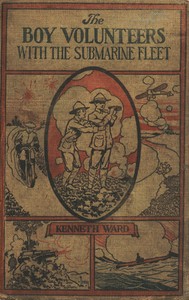
The excerpts are punctuated with precise technical terms—"compressed air tanks," "conning tower," "sub-lieutenant," "ballast"—that ground the story in the mechanics of early submarines. Ward often embeds explanations within dialogue, as when the captain calculates the number of crew members "disposed of" or when Alfred asks about the vessel's angle. This instructional voice is not merely decorative; it serves to build credibility and immerse the reader in the operational realities of a World War I submarine. The line drawings mentioned in the front matter likely reinforced this effect, though the text alone conveys a sense of authenticity through its jargon and procedural details.
Pacing Through Dialogue and Action
The narrative pace is tightly controlled by alternating between calm, strategic conversations and sudden, violent events. In one passage, Alfred casually engages a seaman in conversation, learning about the crew's exhaustion ("hardly an hour's sleep in the last four days"), only to be interrupted by a "rasping sound" that throws the boat into chaos. This rhythm—quiet planning punctuated by explosive action—is a hallmark of the excerpts. The captain's instructions are delivered in a measured tone, but the physical descriptions of the boat "rebounding" and "oscillating" inject urgency. The result is a story that feels both methodical and precarious, mirroring the tension of submarine warfare itself.
Character Voice and Collaborative Agency
The three main characters—Ralph, Alfred, and the captain—speak in a uniformly earnest, problem-solving register. Alfred's dialogue is particularly notable for its strategic use of feigned ignorance; he asks leading questions to extract information from the seaman, while the captain analyzes the crew's injuries and plans a takeover. The boys are not passive observers but active participants, contributing observations (Ralph knows where the injured men are) and taking initiative (Alfred moves a box to start a conversation). This collaborative voice reinforces the series' educational mission: readers learn not just about submarines, but about resourcefulness and teamwork under pressure.
Readers approaching this 1917 boys' adventure should attend to how Ward balances technical instruction with narrative tension. The excerpts suggest a story that rewards careful reading of dialogue for clues about submarine operations and crew dynamics. The pacing—alternating between exposition and crisis—creates a sense of authenticity, even if the full book's resolution remains unknown. This edition invites comparison with other wartime adventure series, particularly in its use of jargon and collaborative problem-solving as narrative devices.
Reader reflection
Before you leave, reflect on the book
Use these questions to collect your thoughts before moving on.
Your progress
0
/
10
2
What was your overall reaction to the book?
3
Would you encourage someone else to read it?
4
What was the reading difficulty like?
5
What did you think about the pace?
6
Which aspect of the book did you value most?
7
Could you see yourself revisiting this book?
8
Did the book give you something worth debating?
9
What did this book teach you most?
10