1

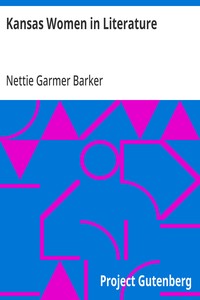
Kansas Women in Literature — Reading Notes
21
2
Project Gutenberg
2008
Women authors, American -- Homes and haunts -- Kansas; Women -- Kansas -- Intellectual life; Kansas -- Biography; Women and literature -- Kansas; Kansas -- In literature
Readers of public-domain and historical texts
Project Gutenberg digital edition
en
Edition facts
Words: 10,033
Reading time: 44 min
Text sections: 2
Source:
Project Gutenberg record #377
Nettie Garmer Barker profiles twenty-two Kansas women writers, using biographical sketches, quoted praise, and excerpts to document their literary output and regional influence in the early twentieth century.
Editorial Edition Score
4.5/5
★★★★★
★★★★★
Calculated from edition completeness, EPUB availability, text structure and catalogue metadata. Not a user rating.
Edition quality
Barker opens with a stanza by Ellen P. Allerton that declares pride in Kansas children “Kansas born!—Or adopted,” immediately framing the collection as inclusive of both native and transplanted writers. The book then proceeds through twenty-two short profiles, each mixing biographical data, quoted commendations, and sample verses or titles. The authorial voice is celebratory and boosterish, leaning on external authorities—ex-governors, critics, and the writers’ own words—to establish literary merit.
The structure is straightforward: a name, a few paragraphs of background, and a closing flourish of quoted lines or publication lists. Barker does not analyze the works in depth; instead, she curates evidence of productivity and public recognition. The result is a reference work that values quantity of output and local reputation over critical evaluation.
Diction of Praise and Proof
Barker’s language is consistently laudatory but specific. She calls Effie Graham “one of the most talented women of the state” and quotes Ex-Gov. Hoch calling her “one of the most gifted women in the state noted for its brilliant women.” The repetition of “state” ties each writer to Kansas geography. For Sallie F. Toler, Barker writes she “has written on every subject from pigs and pole cats to patriotism,” a folksy catalog that signals versatility without analysis. The praise is often external: critics, governors, or magazine staff lists supply authority. Barker herself rarely offers aesthetic judgment, instead letting quoted fragments—like the comparison of Graham’s book to “Mrs. Wiggs of the Cabbage Patch” and “Uncle Tom’s Cabin”—stand in for evaluation.
Voice in the Excerpts: Lyric and Declarative
The quoted verse reveals a range of voices. Margaret Perkins’s lines use formal, romantic diction: “With silken flutter of empurpled wings” and “abloom where age and season never sear.” The tone is elevated, with regular meter and rhyme. In contrast, the opening poem by Ellen P. Allerton is more direct and patriotic: “We are proud of Kansas, the beautiful queen.” Barker’s own prose is factual and brisk, rarely pausing for reflection. When she does characterize a writer’s style, it is in brief phrases: for one poet, “the rhyme easy flowing and strong.” The excerpts thus show a tension between the ornate, sometimes archaic verse of the poets and Barker’s plain, reportorial framing.
Structure as a Catalog of Achievement
Each profile follows a predictable pattern: birthplace or adoption, education, professional roles, list of publications, and a closing quotation or commendation. For instance, Effie Graham’s entry lists her academic posts, lecture titles, and magazine contributions before mentioning her book. The effect is cumulative: the reader sees a series of résumés rather than literary analysis. Barker emphasizes productivity—how many books, how many magazine pieces, how many plays. She notes that Graham’s name is “the only woman’s name on its staff of fifty editors” for School Science & Mathematics, a detail that highlights gender in a male-dominated field. The structure itself argues that these women deserve recognition by sheer volume and variety of output.
Recurring Details: Geography, Lineage, and Labor
Barker repeatedly ties writers to Kansas geography and pioneer ancestry. Anna E. Arnold is “a thorough Kansan, and a farm product”; Eva Morley Murphy is “a descendant of Nathaniel Perry … and of Rodger Williams.” These details root literary achievement in regional and familial soil. Another recurring element is the mention of teaching: many subjects are educators—Graham heads a math department, Perkins is a high school teacher, Arnold is a county superintendent. Barker also notes political engagement: Murphy was “a recent candidate for Congress” and “one of the women who made equal suffrage possible in Kansas.” The profiles thus present writing as one facet of a life of public service, teaching, and civic activism.
Readers approaching Kansas Women in Literature should treat it as a period document rather than a critical study. Barker’s method—collecting names, titles, and testimonials—preserves a snapshot of how literary reputation was constructed in early twentieth-century Kansas. The book rewards those interested in the intersection of gender, regional identity, and the mechanics of canon formation. Pay attention to what Barker chooses to quote and what she omits; the gaps are as telling as the praise.
Reader reflection
How will you remember this book?
Save your reaction, strongest insight, and memorable passage.
Your progress
0
/
10
2
How much did you enjoy the reading experience?
3
How likely are you to recommend this book?
4
How much effort did this book require?
5
Which element worked best for you?
6
How closely did the book connect with your experience?
7
Is this a title worth rereading?
8
How useful were the ideas in this book?
9
What changed or sharpened your thinking?
10