1

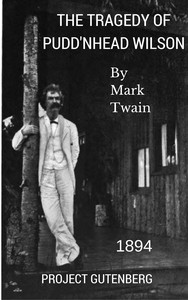
The Tragedy of Pudd'nhead Wilson — Text and Context
605
2
Project Gutenberg
2004
Impostors and imposture -- Fiction; Missouri -- Fiction; Trials (Murder) -- Fiction; Legal stories; Race relations -- Fiction; Infants switched at birth -- Fiction; Passing (Identity) -- Fiction
Readers of public-domain and historical texts
Project Gutenberg digital edition
en
Edition facts
Words: 58,802
Reading time: 256 min
Text sections: 8
Source:
Project Gutenberg record #102
Mark Twain's 1894 novel uses switched identities, a small-town legal case, and Pudd'nhead Wilson's ironic calendar maxims to examine race, heredity, and justice in Dawson's Landing, Missouri.
Editorial Edition Score
4.7/5
★★★★★
★★★★★
Calculated from edition completeness, EPUB availability, text structure and catalogue metadata. Not a user rating.
Edition quality
Twain opens The Tragedy of Pudd'nhead Wilson with a mock-serious "Whisper to the Reader" that warns how "ridicule" can destroy character, using the ass as an example. This sets the tone for a narrative built on ironic reversals and social satire. The author also insists he had a barrister review the legal chapters, a claim delivered with characteristic deadpan humor—the barrister studied law "part of a while" decades ago and now lives in a horse-feed shed. This playful attention to legal detail foreshadows the courtroom climax.
Diction and the Calendar Epigraphs
Each chapter is headed by a quotation from "Pudd'nhead Wilson's Calendar," a fictional almanac whose aphorisms often undercut the action. For example, the opening epigraph observes that even a perfect character can be destroyed by "ridicule, howsoever poor and witless." These sayings are not merely decorative; they provide a sardonic commentary on the events, revealing Wilson's detached, analytical voice. Twain's choice to attribute them to Wilson himself reinforces the character's role as an observer and moral barometer. The calendar entries are terse, paradoxical, and frequently ironic—a stylistic contrast to the more elaborate dialogue of the townspeople.
Dialogue as a Tool of Characterization
Twain renders speech with precise regional and social markers. In the excerpt, Tom Driscoll speaks with a careless, entitled tone: "I don’t care for anything, now that the will’s torn up again." Wilson, by contrast, uses measured, logical language: "That watch isn’t lost, it’s stolen. There’s been another raid on the town." The constable and Justice Robinson contribute brief, colloquial lines that ground the scene in small-town Missouri. Twain also uses dialogue to reveal hypocrisy: Tom claims to have mislaid a ring, but Wilson immediately suspects theft. The exchange exposes Tom's evasiveness and Wilson's sharp deductive reasoning.
Structure and the Unfolding Mystery
The narrative alternates between the switched-infants plot and the detective thread. Chapter titles like "Roxy Plays a Shrewd Trick" and "Pudd'nhead's Startling Discovery" signal key turns. Twain builds suspense through incremental revelations: the thefts of a watch, a pencil-case, and a ring are catalogued before the murder trial. The legal chapters are deliberately paced, with Wilson piecing together evidence from fingerprints—a then-novel forensic technique. The structure mirrors a courtroom process, with each chapter adding a new piece of testimony or clue.
Setting and Social Hierarchy
Dawson's Landing is a sleepy Mississippi River town where social standing is rigidly defined. Twain sketches the setting through details like the "old silver watch that don’t keep time" and the "jack-pair" of Italian twins paraded around town. The town's values are embodied by Judge Driscoll, who demands that Tom fight a duel to defend family honor. Twain uses the setting to critique antebellum Southern codes: the judge's fury at a stolen watch reveals his fear of disorder among slaves. The physical environment—the river, the calaboose, the judge's home—becomes a stage for the collision of inherited status and individual merit.
Readers should attend to Twain's use of fingerprints as both a plot device and a symbol of identity. The novel rewards attention to its layered ironies: Wilson, dismissed as a "pudd'nhead," turns out to be the sharpest mind in town. The tragedy lies not in the courtroom verdict but in the social system that makes such a verdict necessary.
Reader reflection
Record your reading impressions
A brief reflection can help important ideas stay with you longer.
Your progress
0
/
10
2
How much did you enjoy the reading experience?
3
Is this a title you would suggest to others?
4
What was the reading difficulty like?
5
How strongly did the book affect you emotionally?
6
Did the book offer a fresh perspective?
7
Was the book moving at the right speed?
8
How closely did the book connect with your experience?
9
In one sentence, what did you learn?
10