1

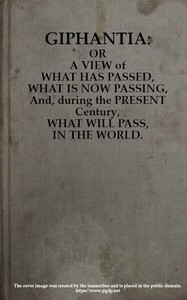
Giphantia Or a View of What Has Passed, What Is Now Passing, and, During the Present Century, What Will Pass, in the World. — Themes and Context
982
8
Project Gutenberg
2019
Utopias -- Fiction; French fiction -- 18th century; Voyages, Imaginary -- Fiction
Readers of public-domain and historical texts
Project Gutenberg digital edition
en
Edition facts
Words: 32,750
Reading time: 143 min
Text sections: 41
Source:
Project Gutenberg record #60058
An 18th-century French utopian novel in which a traveler recounts a visit to the hidden island of Giphantia, where elemental spirits cultivate the three kernels of the forbidden tree—science, arts, and pleasures—to soften humanity's fall. The excerpts reveal a philosophical frame blending biblical allegory with speculative technology, though the catalog subjects of airships and imagined futures are not directly evidenced.
Editorial Edition Score
4.8/5
★★★★★
★★★★★
Calculated from edition completeness, EPUB availability, text structure and catalogue metadata. Not a user rating.
Edition quality
The narrator of Giphantia opens by declaring he has traveled the whole world and burned his memoirs, finding humanity a “monstrous mixture of humanity and barbarousness.” This sweeping dismissal sets the stage for a journey to a hidden island where elemental spirits—not humans—govern society. The excerpts show that the work is framed as a translation from French, with a dedicatory epistle to Miss Ross dated 1761, and includes a table of chapters whose titles hint at philosophical dialogues (“The Discourses,” “The Mirrour”) and natural phenomena (“The Hurricane,” “The Storm”).
The Catalog Subjects and What the Text Actually Shows
The Project Gutenberg record lists “Technology, Airships & Imagined Futures” as a primary category, yet the excerpts contain no airships, flying machines, or mechanical inventions. Instead, the speculative element is entirely supernatural: the “elementary spirits” who govern the elements and cultivate the three kernels from the forbidden apple. The catalog subject “Utopias” is more apt, as Giphantia is presented as a corrective to human folly, but the text’s method is allegorical rather than political. The “imagined future” promised in the subtitle (“a View of What Has Passed, What Is Now Passing, and, during the Present Century, What Will Pass”) is not realized in the provided excerpts, which focus on the past (the Fall) and the present (the narrator’s journey). Readers expecting technological prophecy will find instead a moral and philosophical fable rooted in biblical imagery.
The Tree of Love and the Three Kernels
A central myth in the excerpts is the recovery of three kernels from the forbidden apple after Adam’s expulsion. The spirits plant them, and the first produces the “Tree of Love,” described in ornate detail: “its purple blossoms, speckled with white, were raised round their stalks in form of pyramids.” The narrator is shown a grove where a star-shaped shrub emits luminous matter “whereon were painted all the colours of the rain-bow.” The Prefect of Giphantia explains that this tree’s exhalations transformed human reproduction from “blind instinct” to sentiment, making love superior to all other passions. This allegorical origin story—tying love, science, and arts to the Fall—is the closest the excerpts come to a utopian vision, but it is presented as a remedy for, not an escape from, human suffering.
Structure and Voice: A Frame Narrative with Embedded Discourses
The novel is structured as a first-person travel narrative with extended speeches by the Prefect, who serves as a guide. The table of chapters shows a mix of action (“The Hurricane,” “The Storm”) and philosophical set-pieces (“The Discourses,” “Happiness,” “The Taste of the Age”). The translator’s note emphasizes the work’s French origin and the difficulty of the handwriting, adding a layer of mediation. The narrator’s voice is world-weary and critical of civilization, while the Prefect speaks in a formal, didactic tone. The excerpts do not reveal whether the narrator ever returns from Giphantia or how the “view of what will pass” is delivered, leaving the overall arc unclear. This structure—a disillusioned traveler encountering a hidden sage—is typical of eighteenth-century philosophical romances.
Readers should approach Giphantia as a product of its time: a French philosophical tale that uses a fictional voyage to explore moral and theological ideas. The catalog’s emphasis on technology may mislead; the text’s speculative energy is directed toward allegory, not machinery. Pay attention to the interplay between the narrator’s skepticism and the Prefect’s authoritative explanations, and note how the biblical framework shapes the utopian claims. The work rewards those interested in Enlightenment-era thought experiments rather than predictive science fiction.
Reader reflection
What was your reading experience?
Capture what you thought, learned, and would like to remember.
Your progress
0
/
10
2
What was your overall reaction to the book?
3
Would you encourage someone else to read it?
4
How demanding did the text feel?
5
How much did the book move you?
6
What was the strongest part of the book?
7
Did the book give you something worth debating?
8
How clear did the writing feel?
9
What did this book teach you most?
10