1

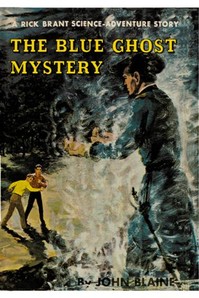
The Blue Ghost Mystery: A Rick Brant Science-Adventure Story — Reading Notes
25
2
Project Gutenberg
2010
Detective and mystery stories; United States -- History -- Civil War, 1861-1865 -- Juvenile fiction; Abandoned mines -- Juvenile fiction
Readers of public-domain and historical texts
Project Gutenberg digital edition
en
Edition facts
Words: 44,485
Reading time: 194 min
Text sections: 5
Source:
Project Gutenberg record #31589
In this Rick Brant science-adventure, cataloged as a Civil War-era mystery, the excerpts reveal a story centered on an optically produced ghost, an ice-cream vendor, and a mine, with the Civil War connection absent from the provided text.
Editorial Edition Score
4.7/5
★★★★★
★★★★★
Calculated from edition completeness, EPUB availability, text structure and catalogue metadata. Not a user rating.
Edition quality
The catalog subjects for The Blue Ghost Mystery list the American Civil War and abandoned mines, yet the excerpts show a story built around an optically produced ghost, a suspicious ice-cream vendor, and a mine that serves as a stage for a hoax. The Civil War, if present, does not appear in the available text. Instead, the narrative focuses on Rick Brant and Scotty applying scientific reasoning—Rick’s knowledge of double exposures and trichocysts—to debunk a supernatural claim. The setting shifts from Spindrift Island to a Virginia farm, where the boys investigate a “Blue Ghost” that has been seen by locals, including a tenant farmer named Belsely. The excerpts emphasize observation, deduction, and the mechanics of the ghost’s appearance, not historical conflict.
Science vs. Superstition
The excerpts position Rick as a young scientist who approaches the ghost mystery with laboratory precision. Early in the text, he is staining microscopic animals and hoping to photograph their trichocysts—a detail that establishes his methodical mindset. Later, he applies this logic to the ghost: “There’s only one way a transparent spook can be produced, and that’s optically. In the movies they use a double exposure.” This line directly ties the ghost to a technical trick, not the supernatural. The tenant farmer Belsely, by contrast, admits he “believed in ghosts” but had the nerve to watch them. The tension between empirical explanation and folk belief drives the investigation, with Rick and Scotty treating the ghost as a puzzle to be solved rather than a phenomenon to be feared.
The Ice-Cream Man as Suspect
A recurring figure in the excerpts is the “Frostola man,” an ice-cream vendor who appears at key moments. Rick and Scotty suspect him of being involved in the ghost’s production, but their assumptions are complicated when Belsely reveals that the vendor also saw the ghost. Rick’s reaction—“Oh, he knows about the ghost, all right. He saw it once”—shows the boys recalibrating their theory. The vendor’s scooter becomes a clue: the boys watch the road to see if he arrives at the mine before the ghost appears, but they fail to spot him. This detail suggests the ghost may be produced from a different location or by a different method. The ice-cream man is a plausible suspect because he is an outsider—not a Virginian—and his mobility allows him to be at the scene, yet the excerpts leave his role ambiguous.
The Mine as a Stage
The abandoned mine, listed as a catalog subject, appears in the excerpts as the setting for the ghost’s appearances. The boys position themselves upstream from the mine to watch the road, and the ghost is “due” at nine o’clock, implying a scheduled performance. The mine is not described as a relic of the Civil War but as a practical location for a hoax: it provides darkness, seclusion, and a dramatic backdrop. The illustrations listed—such as “The timber had given way. They were trapped!”—suggest the mine also serves as a trap later in the story. In the excerpts, however, the mine is primarily a place of observation and waiting, where the boys apply insect repellent and discuss theories. The Civil War connection, if any, remains absent from the provided text.
Readers should note that the catalog subjects may not fully reflect the story’s actual content. The excerpts show a mystery driven by scientific inquiry and a modern (1960) setting, not historical events. The Civil War tag may refer to a subplot or background detail not present in these passages. Approach the book as a puzzle-box mystery where the solution lies in optics and human behavior, not in supernatural or historical forces.
Reader reflection
Record your reading impressions
A brief reflection can help important ideas stay with you longer.
Your progress
0
/
10
2
Was reading this book enjoyable?
3
Is this a title you would suggest to others?
4
How much effort did this book require?
5
Would you read this book again?
6
Would you start a conversation about this book?
7
How did the pace of the book feel?
8
Did anything about the book feel genuinely new?
9
Which lesson or insight stayed with you?
10