1

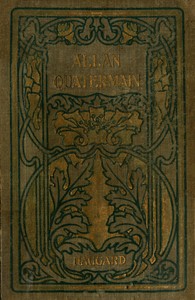
Allan Quatermain — Themes and Context
1260
2
Project Gutenberg
2004
Africa -- Fiction; Fantasy fiction; Adventure stories; Hunting guides -- Fiction; Quatermain, Allan (Fictitious character) -- Fiction
Readers of public-domain and historical texts
Project Gutenberg digital edition
en
Edition facts
Words: 111,226
Reading time: 484 min
Text sections: 29
Source:
Project Gutenberg record #711
H. Rider Haggard's sequel to King Solomon's Mines follows Allan Quatermain's journey into a hidden African kingdom, Zu-Vendis, where he and his companions navigate political intrigue, ritual threats, and a love triangle between two sister queens. The narrative shifts from personal grief to adventure, using sketches, gestures, and visual storytelling to bridge cultural gaps.
Editorial Edition Score
4.9/5
★★★★★
★★★★★
Calculated from edition completeness, EPUB availability, text structure and catalogue metadata. Not a user rating.
Edition quality
The novel opens not with action but with a private diary entry dated December 23, in which Allan Quatermain records the death of his son Harry from smallpox. The grief is raw and unadorned: “I have just buried my boy, my poor handsome boy of whom I was so proud, and my heart is broken.” This personal loss, set against the wealth from King Solomon’s Mines, establishes a melancholic motive for departure. Quatermain’s voice—colloquial, weary, yet precise—shapes the entire narrative. The story then moves abruptly to a consul’s yarn, a framed tale that propels the expedition into unknown territory.
Framed by Grief, Propelled by Curiosity
The diary prologue is a structural anomaly in adventure fiction: a first-person lament that undercuts the expected bravado. Quatermain describes himself as “old and grey and withered,” his son’s death a “black Fate” that crushes all. This emotional weight lingers even as the plot shifts to a consul’s tale of a white woman seen in a remote African valley. The juxtaposition is deliberate—the adventure is born from loss, not mere wanderlust. Haggard uses the diary to ground Quatermain’s subsequent actions in a psychology of escape, though the excerpts do not reveal whether this thread is sustained.
Visual Communication Across Cultures
When Quatermain and his companions are brought before the sister queens Nyleptha and Sorais, language fails. Quatermain resorts to sketching: a lake, an underground river, a hippopotamus. The queens respond in kind, drawing pictures that convey welcome, danger, and protection. One sketch shows Agon the High Priest poking the explorers into a fiery furnace with a forked stick; another depicts the queens shielding Sir Henry with swords. These drawings function as a silent negotiation, revealing character through gesture. Nyleptha’s blush at Sir Henry’s glance, noted by the jealous lord Nasta, adds a layer of unspoken tension that the text treats as observable fact.
The Politics of the Throne Room
The audience scene in the Flower Temple is a masterclass in indirect exposition. Agon demands the strangers be burnt alive; Sorais speaks in a “soft and musical voice” to counter him; Nyleptha pleads in “liquid accents.” Nasta, a suitor for Nyleptha, sides with Agon, his hand tightening on his sword-hilt. Sorais watches with a “suppressed smile,” calculating. The queens’ differing responses—Nyleptha’s flushed anger, Sorais’s cool observation—hint at a power dynamic that will likely drive later conflict. Haggard conveys political maneuvering entirely through physical detail and reported speech, without authorial commentary.
Recurring Images of Fire and Sacrifice
Fire appears as a threat and a symbol. Agon’s drawing of a furnace, the “Rose of Fire” chapter title, and the repeated mention of burning alive create a motif of sacrificial heat. The temple setting, with its flower imagery and cold grey eyes of the priest, contrasts the warmth of the queens’ protection. Quatermain’s diary also uses fire metaphorically: “the great wheel of Fate rolls on like a Juggernaut, and crushes us all in turn.” Whether the narrative resolves this imagery or lets it smolder is unclear from the excerpts, but the pattern is consistent enough to suggest a deliberate thematic thread.
Readers should attend to the way Haggard balances interior grief with exterior spectacle. Quatermain’s narration rarely lingers on emotion after the prologue, yet the diary’s sorrow colors every subsequent risk. The sketches and gestures offer a rare moment of cross-cultural exchange that bypasses language, a technique worth comparing to the verbal negotiations that follow. The political triangle among the queens, Sir Henry, and Nasta is set up with careful restraint—watch for how it unfolds without the narrator’s explicit judgment.
Reader reflection
What was your reading experience?
Capture what you thought, learned, and would like to remember.
Your progress
0
/
10
2
What was your overall reaction to the book?
3
Would you pass this book on to a friend?
4
How much effort did this book require?
5
Did it raise ideas you would like to talk about?
6
Which aspect of the book did you value most?
7
Did the book meet your expectations?
8
How distinctive were its ideas or approach?
9
What did this book teach you most?
10