1

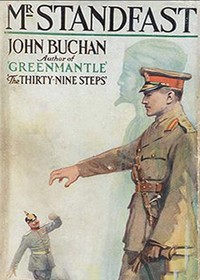
Mr. Standfast — Key Ideas to Explore
1024
2
Project Gutenberg
1996
World War, 1914-1918 -- Fiction; War stories; Spy stories; Hannay, Richard (Fictitious character) -- Fiction; Intelligence service -- Great Britain -- Fiction
Readers of public-domain and historical texts
Project Gutenberg digital edition
en
Edition facts
Words: 135,404
Reading time: 589 min
Text sections: 23
Source:
Project Gutenberg record #560
Richard Hannay, disguised as Cornelius Brand, investigates a German spy network using coded advertisements in newspapers. The narrative shifts from civilian frustration to front-line combat, with Buchan's prose alternating between tense deduction and vivid war scenes.
Editorial Edition Score
4.9/5
★★★★★
★★★★★
Calculated from edition completeness, EPUB availability, text structure and catalogue metadata. Not a user rating.
Edition quality
The novel opens with Richard Hannay in a grey tweed suit, travelling under the alias Cornelius Brand, and seething with frustration at being out of uniform while others fight. Buchan immediately establishes a dual tension: the personal irritation of a soldier forced into civilian disguise, and the broader mystery of a German spy ring operating through coded newspaper advertisements. The narrative voice is brisk, sardonic, and self-aware—Hannay notes his own chestful of medals with dry irony, yet the reader senses his unease at playing a part rather than leading troops.
Buchan’s pacing mirrors Hannay’s shifting moods: the opening train journey is claustrophobic and irritable, the motor-car ride along a trout stream is worried and mystified, and the final tramp through beech-woods brings a quiet, resolute calm. This three-stage movement—from confinement to confusion to clarity—sets a pattern for the entire work, where physical travel and mental deduction are tightly interwoven.
Voice and the Reluctant Spy
Hannay’s first-person narration is colloquial, wry, and grounded in physical detail. He describes his own medals as “a chest like the High Priest’s breastplate,” and his irritation at being mistaken for a shirker is palpable. Buchan avoids melodrama; Hannay’s complaints are those of a practical man forced into subterfuge. The voice is that of a soldier who values action over intrigue, and this tension colours every scene of investigation.
The excerpts show Hannay’s deductive process as a series of concrete observations: he notices that the same “deep-breathing” advertisement appears in both English and German newspapers, that the English papers are bellicose while the German ones are radical, and that four identical sentences hint at a common source. His reasoning is methodical, not flashy—he thinks like a staff officer analysing intelligence, not a detective solving a puzzle. This voice gives the spy plot a credible, workmanlike texture.
Pacing Through Landscape and Mood
Buchan controls the novel’s rhythm by alternating between cramped interiors and open landscapes. The opening chapter moves from a first-class railway carriage (irritation) to a local motor-car following a trout stream (worry) to a tramp over downland through beech-woods (calm). Each setting corresponds to a shift in Hannay’s emotional state and the story’s tempo.
Later, a bout of malaria forces Hannay to lie in a dug-out for three days, slowing the narrative to a crawl. The reader shares his boredom and feverish rumination, which makes the sudden discovery of the coded advertisements all the more startling. Buchan uses physical confinement—whether in a train, a car, or a flooded dug-out—to compress time and heighten the impact of revelations. Conversely, open landscapes like the downland or the trout stream allow for reflection and the gradual unspooling of clues.
Recurring Details and the Cipher of Daily Life
Buchan embeds the spy plot in mundane details: a newspaper advertisement, a suitcase labelled “C.B.”, a wound stripe on a young officer. These small, concrete objects anchor the story in a recognizable wartime world. The “deep-breathing” system is a brilliant cipher because it is so ordinary—anyone might read it without suspicion. Hannay’s breakthrough comes not from a dramatic clue but from noticing a pattern in the placement of advertisements across different newspapers.
The excerpts also show Buchan’s use of repeated motifs: the “Wild Birds” of later chapter titles, the “Cage of the Wild Birds,” and the “Col of the Swallows” suggest a network of natural imagery that may parallel the spy network. Hannay’s own alias, Cornelius Brand, is a small but telling detail—a name that sounds solid and unremarkable, fitting a man who must pass unnoticed. These recurring elements reward close attention without overwhelming the narrative.
Readers should attend to the way Buchan uses physical movement—trains, cars, walks, even air raids—to structure the story’s emotional arc. The novel is less a puzzle-box than a journey narrative, where each new setting brings a change in mood and a fresh piece of the conspiracy. Pay particular attention to the moments when Hannay is stationary or ill; these are often where the most important deductions occur. The voice is that of a man who would rather be fighting, and that reluctance gives the spy work an edge of authenticity.
Reader reflection
Take a moment to reflect on this book
Create a short personal record of your experience with this book.
Your progress
0
/
10
2
What was your overall reaction to the book?
3
Would you encourage someone else to read it?
4
How demanding did the text feel?
5
Would you read this book again?
6
How distinctive were its ideas or approach?
7
Would you like to discuss this book with someone?
8
What did you appreciate most?
9
Which lesson or insight stayed with you?
10