1

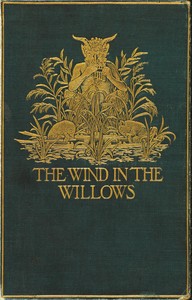
The Wind in the Willows — Reading Companion
28
3
Project Gutenberg
1995
Fantasy fiction; Animals -- Fiction; Humorous stories; England -- Fiction; Friendship -- Fiction; Pastoral fiction; Country life -- Fiction; River life -- Fiction
Readers of public-domain and historical texts
Project Gutenberg digital edition
en
Edition facts
Words: 63,927
Reading time: 278 min
Text sections: 13
Source:
Project Gutenberg record #289
Kenneth Grahame's pastoral fantasy follows Mole, Rat, Badger, and Toad through riverbank adventures, blending humor with lyrical nature writing. The excerpts reveal a precise animal society with its own etiquette, a mystical undercurrent in the Piper chapter, and a narrative voice that shifts between cozy domesticity and mythic resonance.
The opening of The Wind in the Willows introduces Mole not with a grand adventure but with spring-cleaning—a domestic chore rendered in rhythmic, almost percussive prose: “scraped and scratched and scrabbled and scrooged.” This attention to physical detail, from whitewash splashes to the feel of warm grass, establishes a world where animal habits are both familiar and strange. The narrative voice moves easily between earthy humor (Mole jeering “Onion-sauce!” at rabbits) and lyrical description of the riverbank. Yet the catalog subjects—fantasy, humor, pastoral—only partly capture the work’s tonal range. The excerpts also include a haunting, quasi-religious episode where Rat hears a song from the reeds, a passage that resists easy categorization as either fantasy or humor.
Animal Society and Its Codes
The excerpts depict a structured animal world with its own rules and hierarchies. When Mole encounters an elderly rabbit demanding “Sixpence for the privilege of passing by the private road,” the interaction mimics human toll systems, but the rabbit’s authority is immediately undercut by Mole’s contemptuous jeer. This blend of social mimicry and animal instinct recurs throughout. The characters possess distinct domestic spaces: Mole’s underground home, Rat’s riverside dwelling, Badger’s sett. These are not mere backdrops but extensions of personality—Mole’s initial restlessness is tied to his “dark and lowly little house.” The narrative treats animal behavior with consistency: Mole uses paws, not hands; rabbits speak in grumbling chorus. Yet the society also includes boats, whitewash, and the concept of spring-cleaning, creating a hybrid world that is neither fully animal nor fully human. The catalog subject “Animals -- Fiction” is accurate but understates how the text builds a coherent social logic from these details.
The Piper Passage: A Shift in Register
Chapter VII, “The Piper at the Gates of Dawn,” stands apart from the surrounding chapters in tone and content. Rat and Mole search for Otter’s lost son Portly, but the quest culminates not in a rescue but in a mystical encounter. Rat hears a song from the reeds, which he transcribes as verse: “Lest the awe should dwell—And turn your frolic to fret—You shall look on my power at the helping hour—But then you shall forget!” The language shifts from the colloquial dialogue of earlier chapters to a formal, incantatory register. Mole cannot hear the words, and Rat himself admits, “That I do not know” when asked what they mean. This moment introduces a supernatural element—the Piper, presumably the god Pan—that is absent from the catalog subjects. The episode ends with Rat falling silent, “a smile of much happiness on his face,” suggesting an experience beyond rational explanation. This passage complicates the book’s classification as simple pastoral or humorous animal fantasy.
Narrative Voice and Descriptive Texture
Grahame’s narrator employs a distinctive blend of precise observation and emotional amplification. Spring is described as “moving in the air above and in the earth below and around him, penetrating even his dark and lowly little house with its spirit of divine discontent and longing.” The phrase “divine discontent” elevates a mole’s restlessness to something almost spiritual. Physical actions are rendered with onomatopoeic accumulation: “scraped and scratched and scrabbled and scrooged.” Dialogue often carries a theatrical quality, as when rabbits bicker after Mole’s departure: “How stupid you are! Why didn’t you tell him——” The narrator occasionally steps back to comment on events, as with the dry observation “it was then much too late, as is always the case.” This narrative voice is consistent across the excerpts, whether describing a boat journey or a mystical song. The catalog subject “Humorous stories” applies to the rabbit scene and Toad’s antics, but the humor is often undercut by moments of genuine wonder or melancholy, as when Mole feels “strangely tired” after the Piper episode.
Readers approaching The Wind in the Willows through these excerpts will find a work that resists simple classification. The catalog subjects—fantasy, humor, pastoral, friendship—each capture a facet, but the text’s power lies in its juxtapositions: the mundane and the mythic, the comic and the solemn. Pay attention to the shifts in register between chapters, and to how the narrator’s voice modulates from intimate to elevated. The Piper passage, in particular, rewards close reading as a key to the book’s deeper concerns.
Reader reflection
Your personal reading reflection
Build a private reading journal entry for this title.
Your progress
0
/
10
2
Did this book hold your interest?
3
How likely are you to recommend this book?
4
How easy was the book to follow?
5
Did any part of the book stay with you emotionally?
6
How valuable was this book for your own interests?
7
How personally connected did you feel to the book?
8
What did you think about the pace?
9
What is the main idea you are taking away?
10