1

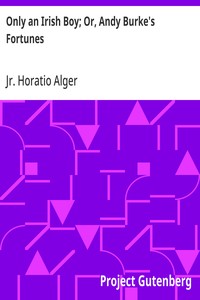
Only an Irish Boy; Or, Andy Burke's Fortunes — Edition Insights
195
0
Project Gutenberg
2004
Conduct of life -- Juvenile fiction; Inheritance and succession -- Juvenile fiction; Irish Americans -- Juvenile fiction
Readers of public-domain and historical texts
Project Gutenberg digital edition
en
Edition facts
Words: 53,275
Reading time: 232 min
Text sections: 9
Source:
Project Gutenberg record #11111
Horatio Alger's 1876 novel follows Andy Burke, an Irish-American boy in Massachusetts, as he navigates class prejudice, defends his mother, and proves his worth through courage and honesty. The excerpts show Alger's characteristic rags-to-riches formula, with Andy's dialect shifting under stress and his resourcefulness in confronting a highwayman.
Editorial Edition Score
4.7/5
★★★★★
★★★★★
Calculated from edition completeness, EPUB availability, text structure and catalogue metadata. Not a user rating.
Edition quality
The novel opens with a clash of authority: Godfrey Preston, a wealthy boy, orders a servant to saddle a sick horse, only to be defied. The servant's quiet resistance—'It's your father that's the master'—immediately establishes a world where social rank is contested. Andy Burke, the titular Irish boy, is not yet present, but the stage is set for his entrance as a counterpoint to Godfrey's arrogance.
Alger signals early that dialect and class are central. Andy's brogue 'more than usual under exciting circumstances' is noted by the narrator, a self-conscious gesture that frames his speech as both authentic and performative. The excerpts also reveal a pattern: Andy's luck turns on acts of bravery, like disarming a highwayman, which earn him rewards and advancement.
Dialect as a Marker of Character
Alger explicitly draws attention to Andy's brogue, noting that he 'always indulged in the brogue more than usual under exciting circumstances.' This is not mere local color; it is a narrative tool. When Andy confronts the highwayman, his speech thickens—'I never attack an inimy in the rare'—marking his emotional intensity. In calmer moments, his dialect recedes, suggesting a code-switching ability that aligns with Alger's theme of upward mobility. The narrator's aside—'I make this explanation, as the reader may have noticed a difference in his dialect at different times'—is a rare metafictional wink, inviting readers to track Andy's linguistic shifts as a barometer of his confidence and social navigation.
The Economy of Generosity
Money changes hands frequently in these excerpts, but always with a moral weight. Colonel Preston offers Andy a reward for saving him from robbery; Andy initially refuses—'I didn't help you for the money'—before accepting for his mother's sake. This pattern recurs: Andy's honesty earns him material gain, but the narrative insists on his disinterest. The highwayman's silver-mounted pistol, which Andy confiscates, becomes a trophy of virtue. Alger uses these transactions to reinforce a simple ethic: good deeds yield tangible returns, and the deserving poor (like Andy's hardworking mother) are the proper recipients of charity. The reader is trained to see every dollar as a sign of character.
Authority and Its Discontents
The opening chapter establishes a hierarchy of command: Godfrey believes he is 'master of the horse,' but the servant John appeals to the colonel's authority. This tension between assumed and actual power runs through the excerpts. Godfrey's imperious tone—'Am I master, or are you?'—is undercut by John's good-humored defiance. Later, Andy himself challenges the highwayman's authority, ordering him to 'go along wid ye!' with a pistol. Alger repeatedly stages scenes where a lower-status character (servant, Irish boy) outmaneuvers a higher-status one (rich boy, robber) through wit or moral clarity. These reversals are the engine of the plot, rewarding readers who root for the underdog.
The Function of the Highwayman Scene
The extended encounter with the highwayman, Fairfax, is the most dramatic excerpt provided. It serves multiple purposes: it showcases Andy's courage ('I didn't stop to think of that when I saw that big blackguard p'intin' his pistol at you'), cements his bond with Colonel Preston, and provides the reward that will likely alter his fortunes. The scene also introduces a recurring Alger motif—the armed confrontation that tests a boy's mettle. Notably, Andy refuses to shoot, using the pistol as a threat rather than a weapon. This restraint aligns with the novel's moral framework: true heroism is defensive, not aggressive. The highwayman's parting threat—'We shall meet again'—hints at future conflict, though the excerpts do not reveal its resolution.
Readers approaching Only an Irish Boy for the first time should attend to how Alger balances dialect, action, and moral lesson. The excerpts suggest a tight structure: each chapter introduces a problem (a bully, a robbery, a class slight) that Andy resolves through pluck and honesty, earning incremental rewards. The novel's title is both a label Andy rejects and a badge he reclaims. Watch for how the phrase 'only an Irish boy' recurs, and note whether Andy's brogue fades as his fortunes rise—a detail that may reveal Alger's assumptions about assimilation and success.
Reader reflection
Record your reading impressions
A brief reflection can help important ideas stay with you longer.
Your progress
0
/
10
2
What was your overall reaction to the book?
3
How likely are you to recommend this book?
4
Did the language feel accessible?
5
Did any part of the book feel personally relevant?
6
How well did it match your expectations?
7
How valuable was this book for your own interests?
8
Would a second reading be valuable?
9
What is the main idea you are taking away?
10