1

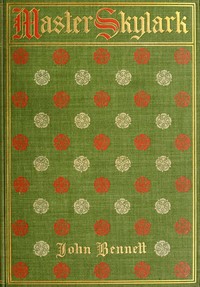
Master Skylark: A Story of Shakspere's Time — Edition Insights
2351
3
Project Gutenberg
2004
Historical fiction; England -- Juvenile fiction; Shakespeare, William, 1564-1616 -- Juvenile fiction
Readers of public-domain and historical texts
Project Gutenberg digital edition
en
Edition facts
Words: 79,158
Reading time: 345 min
Text sections: 42
Source:
Project Gutenberg record #11574
This editorial note examines John Bennett's 1897 novel through its diction, dialogue, and descriptive choices, focusing on the contrast between Stratford's rural life and London's theatrical world as seen by a boy singer.
Editorial Edition Score
4.9/5
★★★★★
★★★★★
Calculated from edition completeness, EPUB availability, text structure and catalogue metadata. Not a user rating.
Edition quality
John Bennett's Master Skylark opens with a simile that sets the tone for the entire novel: the buzz in Stratford is likened to a stick thrust into a hive of bees. This rural, sensory image immediately establishes the world of Nicholas Attwood, a boy whose voice will carry him from the Avon to the Thames. Bennett's prose is rich with such concrete details—the smell of baking bread, the sound of apples dropping in the orchard—that anchor the story in a tangible Elizabethan England. The author's choice to render dialogue in period-inflected dialect, such as "Whur be-est going, Nick?" further grounds the narrative in a specific time and place, while the formal speech of London players and nobles marks a sharp social contrast.
Diction and the Rural-London Divide
Bennett's diction carefully distinguishes between the homely world of Stratford and the sophisticated, sometimes brutal, realm of London. In the excerpts, Nick's memories of home are evoked through simple, sensory nouns: "beehives," "fragrant mint," "baking bread," "harvest apples," and "old bucket in the well." These items are not described with elaborate adjectives; their power lies in their plainness and familiarity. In contrast, London is rendered through exotic spectacles: "wild men with rings in their noses," "wondrous fishes," "puppet-shows," and "red-capped baboons whirling on a pole." The vocabulary shifts from the domestic to the carnivalesque, reflecting Nick's disorientation. Bennett also uses period-specific terms like "spitchcocked eels," "simnel-cakes," and "wherry" to create authenticity without overwhelming the reader. The effect is a world that feels both historically grounded and emotionally immediate.
Dialogue as Character and Conflict
The excerpts offer limited direct dialogue, but what appears reveals character through idiom. The smith's drawled line, "Nobody breaks nobody's hearts in old Jo-ohn Smithses sho-op," uses colloquial repetition and a drawn-out pronunciation to suggest a slow, steady rural voice. In contrast, the stranger's sharp question—"What! How now? ... Dost like or like me not?"—is abrupt and commanding, signaling a more volatile personality. Bennett also uses indirect dialogue to convey Nick's internal state: "Nick thought of his mother's singing on a summer's evening—drew a deep breath and began to sing." The juxtaposition of memory and action shows how song becomes a bridge between worlds. The author's choice to have characters speak in distinct registers—from the rustic "whur be-est" to the courtly "thou shalt have thy wish"—reinforces the social hierarchies that Nick must navigate.
Descriptive Rhythm and Emotional Weight
Bennett's descriptive passages often build a rhythm of accumulation, listing details to create a sense of abundance or longing. For instance, the description of Carew's household piles up foods and pleasures: "wheat-bread the whole week round," "fruit and berries," "honey from the Surrey bee-farms," "spitchcocked eels, pickled herrings, and plums." This list conveys luxury but also excess, mirroring Carew's character as one who "would have nothing but the best, and what he wanted, whether he needed it or not." Conversely, Nick's homesickness is rendered through a similar listing of homely items, but the effect is poignant rather than lavish. The repetition of "and" in "the beehives and the fragrant mint ... the smell of the baking bread or frying carrots, the sound of the red-cheeked harvest apples dropping" creates a cumulative ache. Bennett uses this technique sparingly, making each list feel deliberate and emotionally charged.
Structural Choices: The Journey as Frame
The novel's chapter titles trace a clear geographical and emotional arc: from "The Lord Admiral's Players" and "Nicholas Attwood's Home" through "Off for Coventry" and "London Town" to "Wayfaring Home" and "All's Well That Ends Well." This structure emphasizes movement—both physical and psychological. Bennett devotes early chapters to establishing Stratford's stability before disrupting it, and the middle chapters immerse the reader in London's chaotic variety. The excerpts show how the author uses the journey to introduce new settings and characters, each with their own linguistic and descriptive texture. The Thames pageant, for example, is described with a focus on visual spectacle: "the high carved stern of the bark, painted with England's golden lions." Yet Nick cannot see the Queen herself, a detail that underscores his peripheral status. Bennett's structural choice to keep Nick an observer rather than a participant in many scenes heightens the reader's sense of his vulnerability and longing.
Readers attentive to Bennett's craft will notice how he uses small, recurring details—a bucket in a well, a smith's drawl, a list of foods—to build a world that feels both historically specific and emotionally resonant. The novel's power lies not in grand plot twists but in the accumulation of such moments, and in the contrast between the familiar and the strange as seen through a boy's eyes. Pay attention to the way objects and sounds carry memory, and how dialogue marks social boundaries. These authorial choices make Master Skylark a study in the texture of Elizabethan life as much as a story of adventure.
Reader reflection
Record your reading impressions
A brief reflection can help important ideas stay with you longer.
Your progress
0
/
10
2
How did the book work for you overall?
3
Is this a title you would suggest to others?
4
How demanding did the text feel?
5
Is this a title worth rereading?
6
Did this book create an emotional response?
7
How would you describe its reading pace?
8
Which part made the strongest impression?
9
What is the main idea you are taking away?
10