1

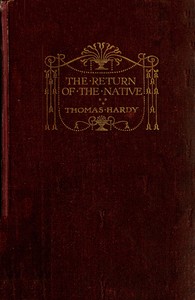
The Return of the Native — Background and Themes
1119
2
Project Gutenberg
2006
Adultery -- Fiction; Didactic fiction; Love stories; Mate selection -- Fiction; Wessex (England) -- Fiction; Mothers and sons -- Fiction; People with visual disabilities -- Fiction; Heathlands -- Fiction
Readers of public-domain and historical texts
Project Gutenberg digital edition
en
Edition facts
Words: 149,117
Reading time: 649 min
Text sections: 51
Source:
Project Gutenberg record #122
Hardy's novel uses the brooding Egdon Heath as a stage for a drama of love, ambition, and miscommunication, structured around the movements of characters across the landscape and the recurring image of the heath's indifferent vastness.
Editorial Edition Score
4.9/5
★★★★★
★★★★★
Calculated from edition completeness, EPUB availability, text structure and catalogue metadata. Not a user rating.
Edition quality
From its opening pages, The Return of the Native establishes Egdon Heath as more than a setting—it is a presence that shapes every human action. Hardy devotes the first chapter to describing the heath's face, on which time makes but little impression, before introducing any character. This inversion of priority signals that the landscape will function as an active force, not a passive backdrop. The novel's structure mirrors this: scenes shift between the heath's open expanses and the enclosed interiors of Blooms-End, Mistover Knap, and the Quiet Woman inn, creating a rhythm of exposure and retreat. Characters are repeatedly described in relation to the heath—Eustacia Vye stands against the sky as a figure of darkness, Clym Yeobright returns to it as a native come home. The heath's unchanging nature throws human restlessness into sharp relief.
The Heath as a Character and a Stage
Hardy's treatment of Egdon Heath goes beyond atmospheric description; it functions as a character with its own moods and agency. The heath is described as having a face, a personality that is "grand" and "sombre." It is not merely a location but an entity that endures while human lives flicker across it. The novel's action is repeatedly framed by the heath's vastness: Eustacia's bonfire on Rainbarrow, the nocturnal walks, the fateful journey across the heath in Book Fourth. These scenes emphasize the heath's scale and indifference. Hardy uses the heath to create a sense of isolation and inevitability, as characters are dwarfed by its expanse. The heath also serves as a meeting place and a barrier, bringing characters together and driving them apart. Its presence is constant, a reminder of the natural world's supremacy over human schemes.
Movement and the Rhythm of Scenes
The novel's structure is built around movement across the heath, with each journey carrying emotional weight. The narrative moves from the heath's open spaces to the interiors of cottages and inns, creating a pattern of approach and withdrawal. For instance, the first book introduces the three women through their encounters on the heath, while later books trace Clym's return and Eustacia's restless wanderings. Hardy often uses the journey itself as a dramatic device: the walk to Blooms-End, the trip to Budmouth, the desperate trek in the rain. These movements are not merely transitions but pivotal events that reveal character and advance conflict. The heath's topography—its barrows, pools, and paths—becomes a map of desire and despair. The recurring image of figures seen against the sky, such as Eustacia on Rainbarrow, underscores the isolation of each character within the landscape.
Recurring Images of Light and Darkness
Hardy employs a consistent visual language of light and darkness to underscore the novel's emotional and thematic tensions. Eustacia is repeatedly associated with darkness and fire: she is the "Queen of Night," her bonfire a signal of defiance and longing. Clym, by contrast, is linked to the sun and to intellectual light, though his eyesight fails him. The heath itself is described in terms of shadow and gloom, with the sun often low on the horizon, casting "thin spectral shadows." These images are not merely decorative; they structure the reader's perception of character and fate. The contrast between Eustacia's fiery passion and Clym's sober idealism is rendered through light: she is a dark flame, he a fading daylight. The novel's climaxes are often bathed in lurid or failing light, as when Eustacia dresses on a black morning or when the wanderers are drawn together by sounds in the rain and darkness.
The Interplay of Speech and Silence
Dialogue in the novel is often sparse and charged, with characters speaking past one another or falling into silence. Hardy uses these moments to highlight miscommunication and isolation. For example, in the excerpt of Clym and Eustacia's farewell, their conversation is punctuated by pauses and repetitions—"If no misfortune happens," she repeats slowly—that hint at unspoken fears. The heath itself is a silent witness, its sounds limited to the wailing of gnats or the rustle of sedge. Characters frequently walk in silence, their thoughts conveyed through gesture and setting rather than words. This restraint gives weight to the few moments of open emotion, such as Eustacia's anguished whisper. The novel's structure of alternating speech and silence mirrors the characters' inability to fully connect, with the heath's vast quietude serving as both a backdrop and a cause of their isolation.
Readers attentive to Hardy's use of landscape will find that the heath is never merely a backdrop but an active participant in the drama. The novel rewards attention to the physical details of setting—the direction of the sun, the texture of the furze, the shape of the shadows—as these often prefigure emotional states or narrative turns. The structure of the novel, with its careful alternation of interior and exterior scenes, invites the reader to consider how place shapes character and fate. Hardy's Egdon Heath is a world unto itself, and understanding its rhythms is key to understanding the lives it contains.
Reader reflection
What was your reading experience?
Capture what you thought, learned, and would like to remember.
Your progress
0
/
10
2
What was your overall reaction to the book?
3
Would you pass this book on to a friend?
4
How easy was the book to follow?
5
Did this book create an emotional response?
6
How would you describe its reading pace?
7
Would a second reading be valuable?
8
Would you like to discuss this book with someone?
9
What did this book teach you most?
10