1

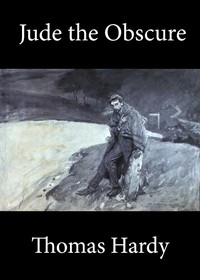
Jude the Obscure — Themes and Context
400
2
Project Gutenberg
1994
Adultery -- Fiction; Didactic fiction; Love stories; Illegitimate children -- Fiction; Wessex (England) -- Fiction; Stonemasons -- Fiction; Children -- Death -- Fiction; Unmarried couples -- Fiction
Readers of public-domain and historical texts
Project Gutenberg digital edition
en
Edition facts
Words: 152,806
Reading time: 665 min
Text sections: 59
Source:
Project Gutenberg record #153
Thomas Hardy's novel follows Jude Fawley, a stonemason with scholarly aspirations, and his cousin Sue Bridehead, tracing their struggles with marriage, class, and societal norms through precise dialogue and descriptive detail.
Thomas Hardy's Jude the Obscure opens with a preface that frames the novel as an attempt to give shape to a series of personal impressions, and the text bears this out through its careful attention to the characters' speech and surroundings. The dialogue between Jude and Sue, for instance, reveals their tensions through small gestures—Sue draws her hand away from Jude's, then relents, calling it a "trick of ours." Hardy's descriptions of setting, like the "withered" geraniums in window pots, mirror emotional states without explicit commentary.
Dialogue as a Window to Inner Conflict
Hardy's dialogue in the excerpted passage is layered with subtext. When Sue says she must tell her husband Richard about holding Jude's hand, Jude replies, "But as it means nothing it may be bothering him needlessly." The exchange exposes their differing views on honesty and propriety. Sue's confession that living with Phillotson as a husband is "a torture" comes after a series of deflections, and Hardy marks her distress with physical detail: she "silently sobbed in little jerks that made the fragile thre..." The broken sentence itself mimics her fragmented state. Such moments show Hardy using speech not just to advance plot but to reveal the characters' internal divisions.
The Weight of Setting and Symbol
Hardy embeds emotional states in the physical environment. The house Jude and Sue occupy is described through its neglected plants—"geraniums and cactuses, withered for want of attention"—which subtly echo the characters' own neglected desires. Sue looks "through them at the outer distance" before her eyes grow moist, linking her inner turmoil to the barren domestic space. The setting is not merely backdrop but an active participant in the narrative, a technique Hardy uses consistently: the house is "gone now," underscoring the transience of their refuge. These details ground the characters' abstract struggles in tangible, often bleak, imagery.
Recurring Motifs of Birds and Freedom
Hardy employs bird imagery to underscore Sue's perceived fragility and entrapment. Jude tells her, "I can see you through your feathers, my poor little bird!"—a line that both infantilizes and sympathizes. Sue's response is to draw her hand away, rejecting the implication of vulnerability. Later, she refers to her marriage as a constraint, and the bird metaphor resonates with her desire for escape. This motif recurs in Hardy's work, but here it is tied specifically to Sue's ambivalence: she is both the caged bird and one who resists the cage. The image is precise, not sentimental, and it reinforces the novel's exploration of social and personal bonds.
Hardy's Narrative Voice and Authorial Distance
Hardy's narrator maintains a measured, almost clinical tone even in moments of high emotion. When Jude says, "It is horrible how we are circumstanced, Sue—horrible!" the narrator reports his words without embellishment, letting the stark repetition carry the weight. The preface's claim that the novel deals "without a mincing of words" with "the tragedy of unfulfilled aims" is borne out in such passages. Hardy avoids authorial intrusion, instead letting dialogue and description accumulate meaning. This restraint creates a sense of inevitability, as if the characters' fates are embedded in their own words and the world they inhabit.
Readers attentive to Hardy's craft will find that Jude the Obscure rewards close attention to its verbal and visual patterns. The novel's power lies not in grand pronouncements but in the accumulation of precise, often painful details—a hand withdrawn, a plant withered, a sentence broken off. These choices invite the reader to read between the lines, where the true drama unfolds.
Reader reflection
Before you leave, reflect on the book
Use these questions to collect your thoughts before moving on.
Your progress
0
/
10
2
Did this book hold your interest?
3
How likely are you to recommend this book?
4
How demanding did the text feel?
5
How much did the book move you?
6
How did the reading compare with what you expected?
7
What did you appreciate most?
8
What did you think about the pace?
9
In one sentence, what did you learn?
10