1

Gargantua and Pantagruel, Illustrated, Book 5 — Edition Insights
10
0
Project Gutenberg
2004
Giants -- Fiction; Fantasy fiction, French -- Translations into English; Gargantua (Legendary character) -- Fiction
Readers of public-domain and historical texts
Project Gutenberg digital edition
en
Edition facts
Words: 52,327
Reading time: 228 min
Text sections: 7
Source:
Project Gutenberg record #8170
This editorial note examines how the opening chapters of Book V establish a satirical bird-island allegory, the middle sections escalate into absurd legal and philosophical encounters, and the later excerpts showcase Rabelais's linguistic play and grotesque feasting, guiding first-time readers through the work's tonal shifts.
Editorial Edition Score
4.7/5
★★★★★
★★★★★
Calculated from edition completeness, EPUB availability, text structure and catalogue metadata. Not a user rating.
Edition quality
The fifth book opens with Pantagruel and his companions arriving at the Ringing Island, where the inhabitants have transformed into birds—a pointed allegory for ecclesiastical hierarchy. The narrator describes the noise as 'a confused sound of many strokes, which seemed to us to be the ringing of bells,' immediately linking the island to church bells and monastic life. The birds are categorized by their roles: pope-hawks, bishop-hawks, and so on, each with distinct behaviors. This avian conceit sets the tone for the book's satirical treatment of institutions, blending fantastical imagery with pointed critique.
The Ringing Island: A Satirical Avian Allegory
The opening chapters establish a clear allegorical framework. The Ringing Island's birds are not mere whimsy; they represent the clergy, with the pope-hawk as the supreme figure. The narrator notes that 'there is but one pope-hawk in the Ringing Island,' mirroring the papacy's singular authority. The birds are described as 'passengers,' suggesting transience or corruption. The dumb Knight-hawks, who cannot speak, parody silent orders or those who follow blindly. This section invites readers to decode the satire: each bird type corresponds to a clerical rank, and their behaviors—such as being 'crammed'—imply gluttony or forced indoctrination. The allegory is consistent and layered, rewarding attention to detail.
From Birds to Law-Cats: Escalating Absurdity
After the Ringing Island, the narrative shifts to the island of Sharping and the domain of Gripe-men-all, Archduke of the Furred Law-cats. Here, the satire targets the legal system. Gripe-men-all propounds a riddle, which Panurge solves, but the encounter reveals how 'the Furred Law-cats live on corruption.' The cats are described with 'long claws and crooked paws,' emphasizing their predatory nature. This section marks a tonal shift from ecclesiastical to legal satire, maintaining the animal metaphor but increasing the menace. The absurdity escalates: the cats' greed is literalized, and the travelers barely escape. Readers should note how Rabelais uses similar structural devices—island visits, riddles, and grotesque personifications—to critique different institutions.
Queen Whims and the Abstractors: Linguistic Play
The later excerpts introduce Queen Whims (Entelechy) and her court of abstractors. The queen's speech is a parody of scholastic jargon: 'The orifice of the ventricle... importunes us to restore... what was dissipated by the internal calidity's action on the radical humidity.' This dense, pseudo-scientific language contrasts with the earlier, more straightforward satire. The queen's officers have titles like 'spodizators, gesinins, memains, and parazons,' and their tasks are absurdly specialized. The queen herself eats nothing but 'celestial ambrosia' and 'divine nectar,' while her masticators chew food for her and pour it down a funnel. This section showcases Rabelais's love of wordplay and his mockery of intellectual pretension. The humor is more cerebral, relying on linguistic invention and parody.
The Olla Podrida: Grotesque Feasting and Hidden Games
One of the most vivid passages describes a feast at Queen Whims's court. After the guests are 'as round as hoops, and as full as eggs,' an enormous olla podrida is served, containing 'pottages, salads, fricassees, saugrenees, cabirotadoes, roast and boiled meat, carbonadoes, swingeing pieces of powdered beef, good old hams, dainty somates, cakes, tarts, a world of curds after the Moorish way, fresh cheese, jellies, and fruit of all sorts.' The narrator laments being too full to eat. At the bottom of the dish are dice, cards, tarots, chessmen, and gold crowns—gaming implements for those who wish to try their luck. This juxtaposition of gluttony and gambling underscores the excesses of the court. The passage also includes mules and litters for those who want to 'take the air,' blending indulgence with absurd practicality.
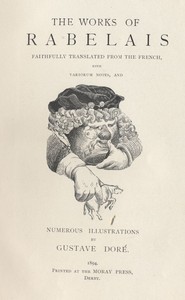
First-time readers should approach Book V as a series of episodic satires, each island offering a new target. The allegories are consistent but not always explicit; the humor ranges from broad slapstick to intricate wordplay. Pay attention to the translators' footnotes, which clarify some of Rabelais's allusions. The illustrations by Gustave Doré, though not excerpted here, complement the text's grotesque and fantastical elements. Reading sequentially, note how the tone shifts from ecclesiastical critique to legal satire to philosophical parody, all while maintaining a carnivalesque energy.
Reader reflection
Take a moment to reflect on this book
Create a short personal record of your experience with this book.
Your progress
0
/
10
2
Was reading this book enjoyable?
3
Would you recommend this book to another reader?
4
How demanding did the text feel?
5
Did any part of the book stay with you emotionally?
6
Would this book work well in a reading group?
7
How would you describe its reading pace?
8
Did you relate to its people, ideas, or situations?
9
What did this book teach you most?
10