1

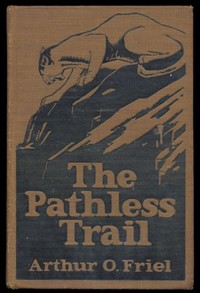
The Pathless Trail — Key Ideas to Explore
2470
2
Project Gutenberg
2009
Fantasy literature; Jungles -- Fiction; Adventure stories; Brazil -- Fiction
Readers of public-domain and historical texts
Project Gutenberg digital edition
en
Edition facts
Words: 79,336
Reading time: 345 min
Text sections: 8
Source:
Project Gutenberg record #30324
An editorial note on Arthur O. Friel's 1922 adventure novel, focusing on its narrative voice, pacing, and use of sensory detail in depicting a jungle expedition in Brazil.
From its opening sentence, The Pathless Trail establishes a deliberate, observational rhythm. Three northern men stand in mud, watching smoke drift—a static tableau that Friel extends through careful physical description and a brief, overheard exchange among local onlookers. The prose moves unhurriedly, letting the reader absorb the scene's texture: the weight of rifles, the squint of eyes, the speculative chatter of bystanders. This measured pace, however, is not uniform; it shifts markedly when the party enters the maloca (communal house) of Chief Monitaya. There, the narrative tightens, dialogue becomes clipped, and the threat of violence sharpens the language. Friel's voice alternates between expansive scene-setting and terse, action-driven passages, a pattern that rewards attention to the rhythm of his sentences.
Voice and the Outsider's Gaze
Friel writes from a third-person perspective that stays close to the white explorers, particularly the leader McKay. The local inhabitants are described from the outside: their filed teeth, black pipes, and feather ornaments are noted, but their interior lives remain opaque. The narrative voice adopts a detached, almost ethnographic tone when rendering the Indians—"the copper-faced men peered at the rifles"—while the northerners' reactions are given emotional weight. This asymmetry creates a consistent point of view: the reader sees the jungle through the explorers' eyes, sharing their wariness and their limited understanding of the people they encounter. The effect is immersive but deliberately one-sided, reinforcing the theme of cultural encounter without pretending to penetrate it.
Pacing and the Threat of Stillness
The novel's pacing is governed by a tension between stillness and sudden action. Early chapters linger on landscape and posture: men stand, smoke drifts, women stare. Dialogue is sparse, often mediated by the interpreter Lourenço. When the party enters the chief's house, the prose compresses: "Within the house the soldiers of fortune halted a moment, adjusting their vision to the sudden diminution of light." The description of the dim interior and the labyrinth of poles and hammocks slows time, heightening suspense. Then, with the subchief's curt words and McKay's hand diving into his haversack for a gift, the pace quickens. Friel uses these shifts to signal danger—the reader learns to read the narrative's tempo as a barometer of threat.
Sensory Detail as World-Building
Friel builds the jungle environment through specific, unglamorous sensory details: ankle-deep mud, the "ribbon of smoke" dissolving above trees, the smell of cooking fires, the sudden dimness inside the maloca. He avoids generic exoticism; instead, he notes the texture of a "heavy hunting knife with a gaudy red-and-white bone handle" and the precise colors of feather headbands ("green, blue, and black plumes"). These details ground the story in a tangible world. The narrative also registers sound sparingly—the grunt of a subchief, the murmur of speculation—which makes the rare moments of dialogue stand out. This restraint in sensory description gives the novel a documentary quality, as if the reader is observing alongside the characters rather than being told what to feel.
Readers attuned to shifts in prose rhythm will find The Pathless Trail a study in controlled tension. Friel's narrative voice remains steady even when events turn uncertain, and his eye for concrete detail—a squirrel-tail tassel, a filed tooth, a holster hiding a pistol—keeps the story grounded. Pay attention to how the length of paragraphs and the frequency of dialogue change as the explorers move deeper into the bush; these variations are the novel's quiet signals of rising stakes.
Reader reflection
Take a moment to reflect on this book
Create a short personal record of your experience with this book.
Your progress
0
/
10
2
Did this book hold your interest?
3
Would you pass this book on to a friend?
4
What was the reading difficulty like?
5
What was its emotional impact?
6
How did the reading compare with what you expected?
7
Which aspect of the book did you value most?
8
How distinctive were its ideas or approach?
9
What is the main idea you are taking away?
10