1

Adventures of Huckleberry Finn — Reading Notes
263
3
Project Gutenberg
2004
Humorous stories; Bildungsromans; Boys -- Fiction; Male friendship -- Fiction; Adventure stories; Missouri -- Fiction; Race relations -- Fiction; Runaway children -- Fiction; Finn, Huckleberry (Fictitious character) -- Fiction; Fugitive slaves -- Fiction; Mississippi River -- Fiction
Readers of public-domain and historical texts
Project Gutenberg digital edition
en
Edition facts
Words: 121,112
Reading time: 527 min
Text sections: 48
Source:
Project Gutenberg record #76
Mark Twain's Adventures of Huckleberry Finn, narrated in Huck's vernacular, follows his escape from civilization and a journey down the Mississippi with the runaway slave Jim. The excerpts reveal a voice that mixes colloquial observation with moral tension, as seen in the circus scene and Sherburn's confrontation with a mob.
Editorial Edition Score
4.9/5
★★★★★
★★★★★
Calculated from edition completeness, EPUB availability, text structure and catalogue metadata. Not a user rating.
Edition quality
From its first chapter, Adventures of Huckleberry Finn establishes a narrator who speaks in a distinct, colloquial voice, referring to himself as “a body” and describing events with a blend of innocence and shrewd practicality. The opening chapters, titled with Twain’s characteristic irony—“Civilizing Huck” and “Tom Sawyer’s Waits”—signal that this is a story about rules and their subversion. Huck’s matter-of-fact tone, even when recounting his father’s abuse or his own staged death, invites readers to trust his perspective while remaining alert to what he does not say.
Huck’s Voice and Vernacular
The excerpts show how Huck’s language shapes the reader’s experience. He describes the circus as “a real bully circus” and the performers as “looking just like a gang of real sure-enough queens.” His grammar is consistently nonstandard—“I never see anything so lovely”—and his similes are drawn from his own limited world: the ladies’ dresses are “rose-leafy,” the horses “lean over and hump themselves.” This vernacular is not merely decorative; it establishes Huck as an observer who reports sensory details without abstract commentary. When he watches the mob disperse after Sherburn’s speech, he notes simply, “I could a staid if I wanted to, but I didn’t want to.” The reader must infer his unease from what he omits.
The Circus and the Mob: Two Kinds of Spectacle
Two extended passages in the excerpts—the circus performance and Colonel Sherburn’s confrontation with a lynch mob—offer contrasting public spectacles. The circus is described with exuberant, almost breathless accumulation: “faster and faster they went, all of them dancing, first one foot out in the air and then the other.” Huck is fully absorbed, marveling at the clown’s quick wit and the riders’ grace. In the mob scene, Sherburn’s speech is a cold, analytical dismantling of collective courage: “The pitifulest thing out is a mob; that’s what an army is—a mob.” Huck’s narration here is terse, reporting the crowd’s retreat without commentary. The juxtaposition suggests that Huck is more comfortable with staged illusion than with the raw social dynamics of the town.
Moral Ambiguity and the Reader’s Role
Huck’s narrative rarely judges events directly, leaving the reader to assess the moral weight. When he sneaks into the circus to save his money, he rationalizes: “there ain’t no telling how soon you are going to need it, away from home and amongst strangers that way.” The logic is practical, not ethical. Similarly, Sherburn’s speech condemns the mob’s cowardice, but Huck does not endorse or reject it—he simply moves on to the circus. This pattern recurs throughout the excerpts: Huck records cruelty, hypocrisy, and kindness with the same flat tone. Readers must decide whether his detachment signals complicity, survival instinct, or a dawning moral awareness that he cannot yet articulate.
Structure and Pacing in the Excerpts
The excerpts reveal a narrative that alternates between tight, dramatic scenes and looser, observational passages. The circus description is a single, unbroken paragraph that builds rhythm through repetition and coordinating conjunctions: “and then one by one they got up and stood, and went a-weaving around the ring.” In contrast, the mob scene is broken by dialogue and action, with Sherburn’s long speech creating a pause before the crowd disperses. Huck’s transitions are abrupt: “I could a staid if I wanted to, but I didn’t want to. I went to the circus.” This jump-cut technique keeps the narrative moving and mirrors Huck’s restless attention. Readers should note how these shifts in pace affect their own engagement with the story’s moral questions.
Illustrations and the Text
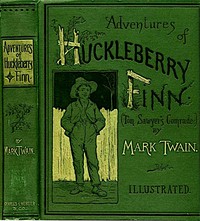
E. W. Kemble’s illustrations, mentioned in the title page, are an integral part of the original edition. The excerpts do not include images, but the text itself often describes scenes that would have been depicted visually—the circus riders, the mob, the raft. Readers of this digital edition may wish to consult the original illustrated version to see how Kemble interpreted Huck’s world. The illustrations often add a layer of satire or sentiment that complements Twain’s prose, particularly in the portrayal of Jim and other characters.
As you read, pay attention to the moments when Huck’s voice wavers—when he hesitates, lies, or withholds judgment. These are the points where the novel’s moral complexity is most concentrated. The excerpts offer a microcosm of the whole: a boy navigating a world of spectacle and violence, guided by a conscience he does not fully trust.
Reader reflection
Your personal reading reflection
Build a private reading journal entry for this title.
Your progress
0
/
10
2
Was reading this book enjoyable?
3
Would you recommend this book to another reader?
4
How demanding did the text feel?
5
Do you expect to return to this book?
6
How much did the book move you?
7
Would this book work well in a reading group?
8
What did you think about the pace?
9
What did this book teach you most?
10